When you’re teaching several pupils every week, remembering exactly where each person left off isn’t always as easy as it sounds.
You might remember that a pupil worked on roundabouts, but was the main issue their approach speed, observations, lane position or decision-making?
Good pupil progress tracking isn’t about writing pages of notes after every driving lesson. It’s about recording just enough useful information to help you pick up where you left off next time.
As a driving instructor, I’ve found that the most useful records are often the simplest ones.
What is worth recording after a driving lesson?
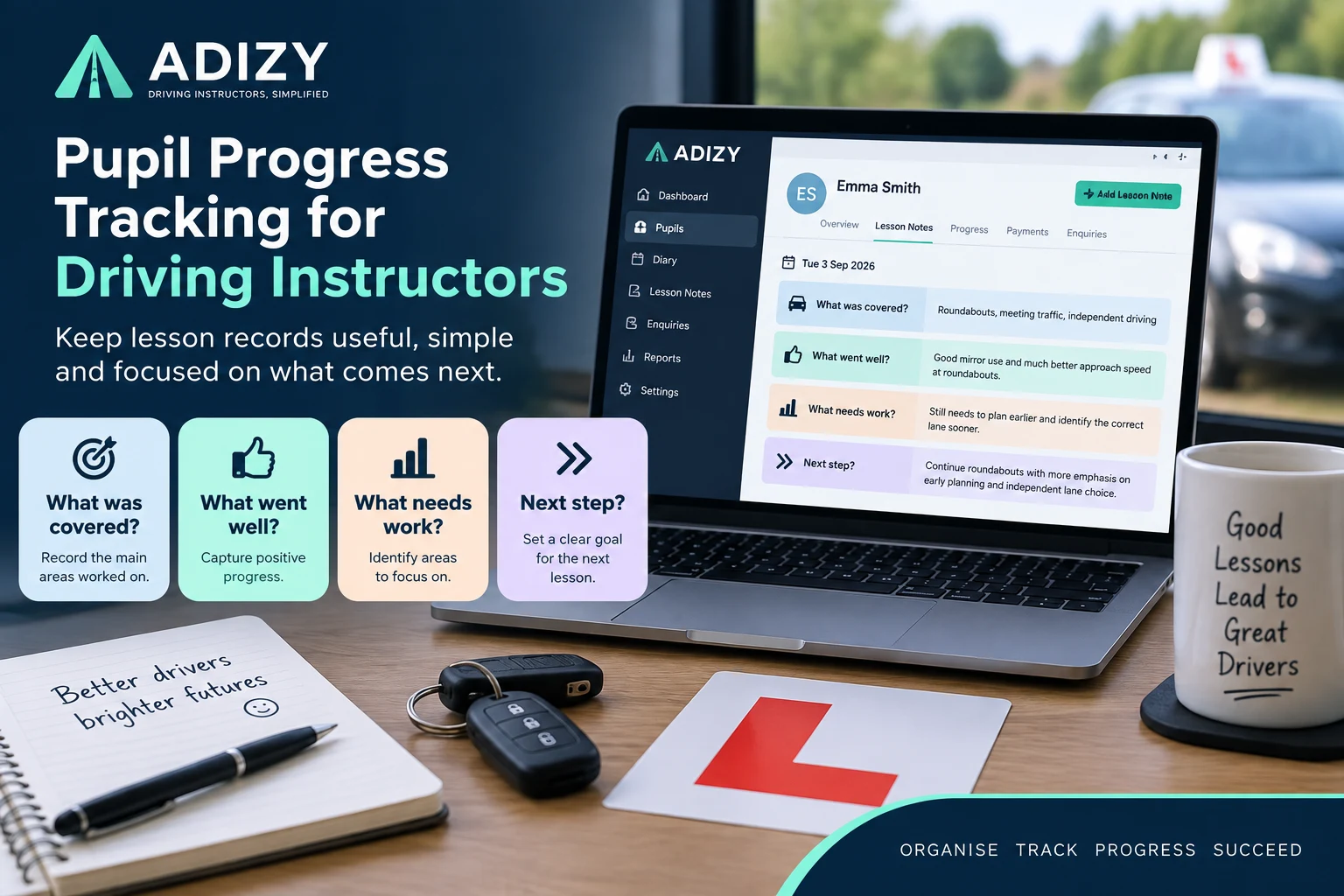
You don’t necessarily need a complicated assessment after every lesson. A useful lesson record can answer four straightforward questions:
1. What did you cover?
Record the main areas worked on during the lesson. For example:
- Roundabouts
- Junctions
- Meeting traffic
- Manoeuvres
- Independent driving
You don’t need to record everything that happened. Concentrate on what was relevant to the lesson.
2. What went well?
Record something useful about the pupil’s progress. For example:
“Good mirror use and much better approach speed at roundabouts.”
This gives you a quick reminder of what was beginning to become more consistent.
3. What still needs work?
This is often more useful than simply giving a pupil a score. For example:
“Still needs to plan earlier when approaching busy roundabouts and identify the correct lane sooner.”
When you read that before the next lesson, you immediately have something useful to work with.
4. What is the next step?
Finish with a simple goal for the next lesson. For example:
“Continue roundabouts with more emphasis on early planning and independent lane choice.”
Now the next lesson already has a starting point.
Why simple lesson notes can be more useful
It’s easy for pupil records to become another piece of driving-school administration. If recording progress takes too long, you’re less likely to keep doing it consistently.
The aim should therefore be to record useful information rather than lots of information.
Covered: Roundabouts and meeting traffic
Went well: Better observations and speed control
Needs work: Earlier planning and lane choice
Next lesson: More independent roundabout practice
That short record can potentially tell you more when you return to that pupil than a long paragraph written several weeks earlier.
Look for patterns, not just individual mistakes
Progress tracking becomes particularly useful when you can look back over several lessons. A pupil might make one mistake with mirrors during a lesson, but that doesn’t necessarily tell you very much.
If your driving lesson records repeatedly mention late mirror checks, planning too late, approach speed or hesitation at junctions, you’ve started to identify a pattern.
That can help you decide where lesson time is most useful and have a better conversation with the pupil about their progress. Instead of simply saying, “You need to improve your planning,” you can discuss where that issue has been appearing and what the pupil can do differently.
Progress isn’t always a straight line
Pupil progress doesn’t always move neatly from one subject to the next. Someone might drive a roundabout well one week and struggle with the same situation the following week.
Traffic conditions change. Roads change. Confidence changes. The amount of help you provide changes too.
That’s why progress records should support your judgement as an instructor rather than replace it. The record gives you information; you still decide what that information means for the next lesson.
Don’t decide the next lesson too early
Previous lesson notes are useful, but they shouldn’t lock you into a lesson plan. You might have written “Next lesson: Roundabouts” and then discover at the beginning of the next lesson that something else needs attention.
Your records should help you arrive prepared while still allowing the lesson to respond to the pupil in front of you.
What should pupil progress software actually do?
A driving instructor app or pupil progress system doesn’t need to make teaching complicated. At a basic level, it should make it easier to:
- find a pupil quickly
- see recent lessons
- record what was covered and what went well
- identify what needs more practice
- record a goal or next step
- see progress over time
The software should support the lesson rather than become the lesson. If you spend longer updating the system than thinking about the pupil, something has probably gone wrong.
Paper, spreadsheet or driving instructor app?
There isn’t one correct way to keep pupil records. Some instructors are perfectly comfortable using paper; others use spreadsheets or notes on their phone.
A dedicated driving instructor app becomes useful when you want pupil details, lesson records, progress and your diary available in one place. The important question isn’t “Which system has the most features?” It’s “Will I actually use this after a busy day of lessons?”
A simple system that gets used consistently is likely to be more useful than a complicated system that doesn’t.
How ADIZY approaches pupil progress
This is one of the reasons I created ADIZY. I wanted a straightforward way to keep the useful parts of a pupil’s learning record close at hand without turning every lesson into an admin exercise.
ADIZY lets Approved Driving Instructors and Potential Driving Instructors keep pupil information, lesson records, progress, lesson notes and next steps together. You can explore the relevant pupil tracking and lesson-note features to see how it works.
After a lesson, the focus is deliberately simple: what was covered, what went well, what needs work and what’s the goal for next time?
Those four pieces of information can give you a useful starting point when that pupil gets back into the car.
Keep it useful
Pupil progress tracking doesn’t have to mean more paperwork. Done well, it should actually reduce the amount you need to remember.
Record what matters. Look for patterns. Use your notes to prepare. Then teach the pupil in front of you.
For a simple way to capture each lesson’s next step, see our guide to structuring lesson notes. You can also explore more practical resources for driving instructors.
For the test-result patterns DVSA monitors, see our guide to DVSA Standards Checks and your pupils’ test results.